🎧 Listen to this article
Table of Contents
- What is Performance Max 2026? Decoding the Future of Digital Advertising
- The Evolution: From Automated Bidding to Autonomous Campaigns
- How AI Will Impact Performance Max: 2026 Predictions
- The Global Advantage: Why Businesses in the USA Need Performance Max AI Strategies
- Gaining a Competitive Edge in the USA Market
- How to Use AI in Marketing to Adapt to Local Consumer Trends
- Navigating Privacy Regulations (like GDPR/CCPA) with AI-Powered Conversion Modeling
- The AI Playbook for Performance Max: 5 Future-Proofing Strategies
- Strategy 1: Mastering AI-Ready Data & Signals
- Strategy 2: AI-Augmented Creative Excellence
- Strategy 3: Predictive Analytics & Forecasting
- Strategy 4: The Symbiotic Role of the Human Marketer
- Preparing Today for Performance Max 2026: Actionable Steps for Your Business
- Step 1: Maximize Current AI in Digital Marketing Tools (Smart Bidding, Broad Match)
- Step 2: Invest in a Unified Data Infrastructure (Your AI’s Fuel)
- Step 3: Begin Experimenting with AI-powered creative and analytics platforms
- Step 4: Foster a Culture of Learning and Adaptation Within Your Team
- Conclusion: Your Future in AI-Powered Advertising Starts Now
- FAQ: Answering Your Questions on the Future of Performance Max
- What are the top Performance Max 2026 predictions?
- How will AI change the role of a PPC manager?
- What are the most important Performance Max AI strategies to focus on?
- How can small businesses in the USA leverage AI in digital marketing?
By 2026, the digital advertising landscape will be unrecognizable. The driver? Artificial Intelligence. The relentless march of AI is reshaping every facet of how brands connect with consumers. At the forefront of this revolution is Google’s Performance Max, currently the pinnacle of AI-driven advertising, which automates targeting and bidding across all of Google’s channels to find more converting customers.
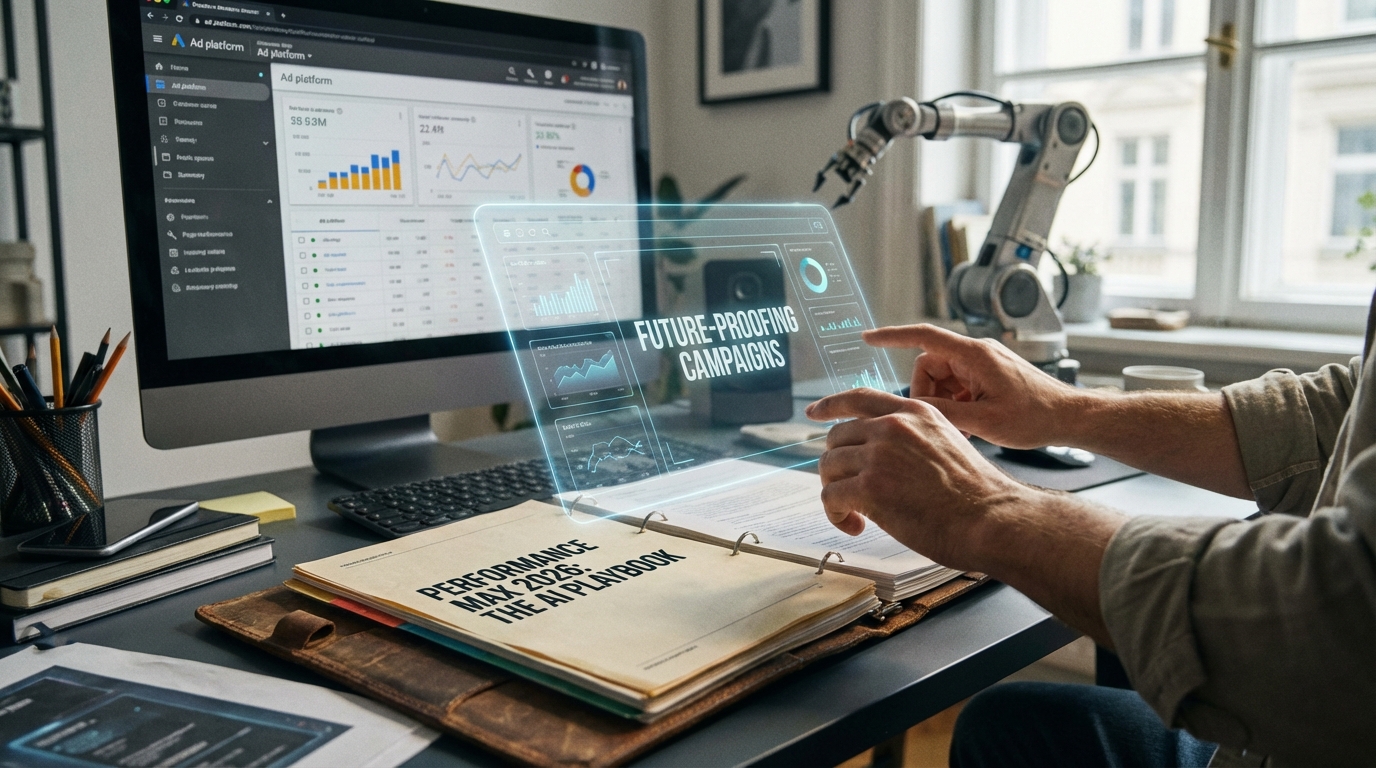
But what comes next is the real game-changer. Welcome to ‘Performance Max 2026’—a forward-look at how predictive analytics, generative AI, and autonomous optimizations will reshape campaigns into intelligent, self-guiding growth engines.[9] This article is your AI playbook for mastering the future of Pay Per Click Advertising and future-proofing your campaigns for the new era.
What is Performance Max 2026? Decoding the Future of Digital Advertising
Performance Max 2026 represents a fundamental shift in campaign management. It’s the next logical step in the evolution of AI in digital marketing, moving beyond simple automation to create truly autonomous and predictive advertising ecosystems.

The Evolution: From Automated Bidding to Autonomous Campaigns
For years, marketers have leveraged AI for specific tasks like Smart Bidding. However, the future lies in campaigns that not only execute tasks but also optimize themselves based on real-time performance data.[5] By 2026, Performance Max will transition from a tool you manage to a strategic partner that operates with increasing autonomy, making complex decisions without human intervention.[6]
This evolution means the system will not just react to market changes but proactively anticipate them. It will learn from vast datasets to forecast trends, identify new audience pockets, and allocate budgets with a level of precision and speed that is humanly impossible.
How AI Will Impact Performance Max: 2026 Predictions
The AI-driven transformation of Performance Max will manifest in several powerful capabilities that will redefine campaign effectiveness and efficiency.
Hyper-Personalized Ad Experiences at Scale
One of the most significant impacts of AI will be in delivering hyper-personalized ad experiences. By analyzing user data—including browsing behavior, purchase history, and location—AI will tailor ad content, product recommendations, and offers to individual preferences in real time. This will allow for dynamic advertising where campaigns automatically adjust messaging and visuals for each user across multiple platforms.
Predictive Audience Generation and Real-Time Targeting
Instead of just targeting audiences you define, Performance Max in 2026 will predict and generate new high-value audience segments autonomously. By analyzing patterns in your first-party data and broad market signals, the AI will identify and target emerging consumer groups likely to convert. This shift from reactive to proactive targeting will become a significant competitive advantage.
Fully Automated Creative Development (Text, Image, and Video)
Generative AI is already making its way into Performance Max, allowing advertisers to create new text and image assets with a few clicks. By 2026, this capability will be vastly more sophisticated. AI will be able to generate entire suites of on-brand ad creatives—including text, images, and videos—and then test thousands of variations to find the winning combinations automatically. This allows for creative optimization at an unprecedented scale.
Proactive Budget Optimization Across the Entire Funnel
AI will enable dynamic, real-time budget allocation across the entire marketing funnel. By analyzing performance data every few hours, AI algorithms will automatically shift spend from underperforming assets or channels to those delivering the highest return on investment (ROI). This ensures every dollar is spent where it can make the biggest impact, maximizing efficiency and growth.

The Global Advantage: Why Businesses in the USA Need Performance Max AI Strategies
In the fiercely competitive US market, embracing AI is not just an option—it’s a necessity for survival and growth. Early adoption of these advanced strategies provides a critical edge.
Gaining a Competitive Edge in the USA Market
The American market is crowded and expensive. Businesses that leverage AI to optimize their Pay Per Click Google Adwords campaigns will outperform competitors by making smarter, faster, and more efficient decisions. AI-driven insights allow for more precise targeting and personalization, cutting through the noise to reach high-intent customers before the competition does.
How to Use AI in Marketing to Adapt to Local Consumer Trends
The United States is not a monolith; consumer behavior varies dramatically by region, state, and even city. AI excels at analyzing vast datasets to identify subtle local trends and preferences. This allows businesses to tailor messaging and offers that resonate with specific local audiences, making campaigns more relevant and effective.
Navigating Privacy Regulations (like GDPR/CCPA) with AI-Powered Conversion Modeling
With the phase-out of third-party cookies and tightening privacy laws like the California Consumer Privacy Act (CCPA), advertisers face challenges in tracking and measurement. AI-powered conversion modeling helps fill these gaps. By using machine learning to analyze non-identifiable signals, it can model conversions that can’t be observed directly, ensuring you can still measure performance accurately while respecting user privacy.
The AI Playbook for Performance Max: 5 Future-Proofing Strategies
To succeed in 2026, you must prepare your campaigns and data for an AI-first world. This playbook outlines five essential strategies to start implementing today.
Strategy 1: Mastering AI-Ready Data & Signals
AI is only as intelligent as the data it learns from. A robust first-party data strategy is the foundation of any successful AI-driven advertising effort.
The Critical Role of High-Quality First-Party Data
First-party data—information you collect directly from your customers via your website, CRM, or app—is your most valuable asset. It is accurate, relevant, and compliant with privacy regulations. Feeding high-quality data into Performance Max allows its AI to learn about your most valuable customers and find more like them.
Leveraging AI for Advanced Customer Lifetime Value (CLV) Prediction
AI can analyze your customer data to predict their long-term value with remarkable accuracy. By identifying customers with the highest potential CLV, you can tailor marketing strategies to improve retention and maximize long-term profitability. These predictions serve as powerful signals for the campaign AI.
Building Smarter Audience Signals for the AI to Learn From
Your audience signals guide the Performance Max AI, helping it find the right customers faster. Go beyond basic demographics. Create detailed audience segments based on past purchase behavior, website engagement, and predicted CLV to give the AI richer, more nuanced data to learn from.
Strategy 2: AI-Augmented Creative Excellence
While AI can automate creative production, human oversight and strategy remain crucial. The goal is to blend AI’s speed and scale with human creativity and insight.

Key AI Applications in Marketing: Using Generative AI for Asset Creation
Leverage generative AI tools to rapidly produce a wide variety of ad assets. These tools can generate dozens of headlines, descriptions, and images in seconds, saving hours of manual work and providing a constant stream of new creative to test.[10]
Dynamic Creative Optimization Tailored to Local Nuances in Raleigh
For businesses targeting specific regions, like those managed by a Raleigh PPC Management Agency, AI can dynamically tailor creative elements. It can adjust imagery, messaging, and calls-to-action based on local events, weather, or consumer preferences, ensuring ads are always highly relevant.
Letting AI run large-scale A/B tests to find winning combinations automatically
The days of manually testing one ad variation against another are over. AI can run thousands of micro-tests simultaneously, mixing and matching headlines, images, and descriptions to identify the highest-performing combinations for different audience segments.[5]
Strategy 3: Predictive Analytics & Forecasting
By 2026, marketing will shift from reacting to past performance to proactively shaping future outcomes. Predictive analytics, powered by AI, is the key to this transformation.
Using AI to Forecast Market Trends and Consumer Demand
AI algorithms can analyze historical data and real-time market signals to predict future trends and shifts in consumer demand. This allows you to prepare your campaigns, inventory, and messaging in advance, capitalizing on opportunities before they fully emerge.
AI-Powered Competitor Analysis and Opportunity Identification
AI tools can monitor your competitors’ digital footprint—analyzing their ad copy, keyword strategy, and landing pages.[1] This provides invaluable insights into their strategies, helping you identify gaps in the market and uncover new opportunities for growth.
Future-Proofing Digital Campaigns with AI-driven budget allocation
Predictive models can forecast the potential ROI of different budget allocation scenarios. This helps you make more strategic decisions about where to invest your marketing dollars, a crucial component of developing something like The 2026 Small Business PPC Budget Blueprint: How Much to …. AI ensures your budget is allocated not just based on past performance, but on future potential.
Strategy 4: The Symbiotic Role of the Human Marketer
AI will not replace marketers; it will empower them. The role will evolve from manual campaign execution to high-level strategic direction.[9][4]
| Traditional PPC Role | The 2026 AI Strategist Role |
|---|---|
| Manual Bid Adjustments | Setting Strategic Bidding Goals |
| Keyword Research | Defining High-Level Search Themes |
| A/B Testing Ad Copy | Curating AI-Generated Creative |
| Building Reports | Interpreting AI-Driven Insights |
| Campaign Monitoring | Prompt Engineering & AI Direction |
Shifting from Campaign Manager to AI Strategist & Director
In 2026, marketers will spend less time on tedious, repetitive tasks and more time on strategy. Your job will be to set the goals, define the strategic guardrails, and provide the AI with the right data and creative inputs to succeed.
Core Skills for 2026: Strategic Oversight, Data Interpretation, and Prompt Engineering
The most valuable skills will be the ability to think strategically, interpret complex data to find actionable insights, and effectively communicate with AI systems through prompt engineering. Understanding What is Google Pay Per Click? will remain fundamental, but applying that knowledge at a strategic level will be key.
Using AI insights to drive high-level business strategy
The insights generated by advertising AI will have implications far beyond the marketing department. Trends in consumer behavior and product demand can inform inventory management, product development, and overall business strategy, making the marketer a more vital contributor to the company’s success.
Preparing Today for Performance Max 2026: Actionable Steps for Your Business
The future of AI-powered advertising is approaching quickly. Businesses that prepare now will have a significant advantage. Here are four steps you can take today.
Step 1: Maximize Current AI in Digital Marketing Tools (Smart Bidding, Broad Match)
Start by fully embracing the AI tools already available in Google Ads. Use Smart Bidding strategies, test broad match keywords with audience signals, and get comfortable letting the machine learning algorithms do their work. This builds a foundational understanding of how to work with AI.
Step 2: Invest in a Unified Data Infrastructure (Your AI’s Fuel)
Your first-party data is critical, but it’s often fragmented across different systems (CRM, email platform, website analytics). Invest in a customer data platform (CDP) or similar solution to unify this data into a single, structured view that the AI can easily access and analyze.
Step 3: Begin Experimenting with AI-powered creative and analytics platforms
Start exploring the ecosystem of AI marketing tools.[2] Experiment with generative AI platforms for creating ad copy and images. Use AI-powered analytics tools to gain deeper insights from your campaign data.[10] This hands-on experience is invaluable.
Step 4: Foster a Culture of Learning and Adaptation Within Your Team
The pace of change will only accelerate. Encourage your team to stay curious, test new tools, and continuously learn about the latest advancements in AI. An agile and adaptive culture is the ultimate key to future-proofing your business.
Conclusion: Your Future in AI-Powered Advertising Starts Now
The predictions for Performance Max 2026 paint a clear picture: AI is not just a feature, but the fundamental operating system of future advertising. Campaigns will become more intelligent, predictive, and autonomous, delivering a level of performance and personalization previously unimaginable.[9]
This future is not about machines replacing humans, but about a powerful collaboration between human strategy and machine intelligence.[8] The marketers who thrive will be those who can effectively direct AI, interpret its insights, and use them to drive business growth. The journey to 2026 starts with the steps you take today.
Ready to future-proof your advertising? Contact our Performance Max experts in Raleigh to build your AI playbook today.
FAQ: Answering Your Questions on the Future of Performance Max
What are the top Performance Max 2026 predictions?
The top predictions include the rise of fully autonomous campaigns, hyper-personalized ad experiences delivered at scale, predictive audience generation, fully automated creative development using generative AI, and proactive, real-time budget optimization across all channels.[5][6][7]
How will AI change the role of a PPC manager?
The role of a PPC manager will shift from a hands-on campaign technician to a high-level AI strategist. Core responsibilities will move from manual tasks like bidding and reporting to strategic oversight, data interpretation, creative direction, and prompt engineering to guide the AI.[4]
What are the most important Performance Max AI strategies to focus on?
The most critical strategies are building a high-quality first-party data foundation, embracing AI-augmented creative processes, leveraging predictive analytics for forecasting, and developing the strategic skills within your team to effectively direct and interpret AI-driven campaigns.
How can small businesses in the USA leverage AI in digital marketing?
Small businesses can start by using accessible AI tools for content creation, email marketing, and social media management.[2][3] In Google Ads, fully adopting features like Smart Bidding and Performance Max allows them to access enterprise-level AI without needing a large team, leveling the playing field and enabling them to compete more effectively.[1]